
Differences Between Ser and Estar?
If you’re looking for a quick and simplistic answer to the differences between ser and estar, this is not your blog.
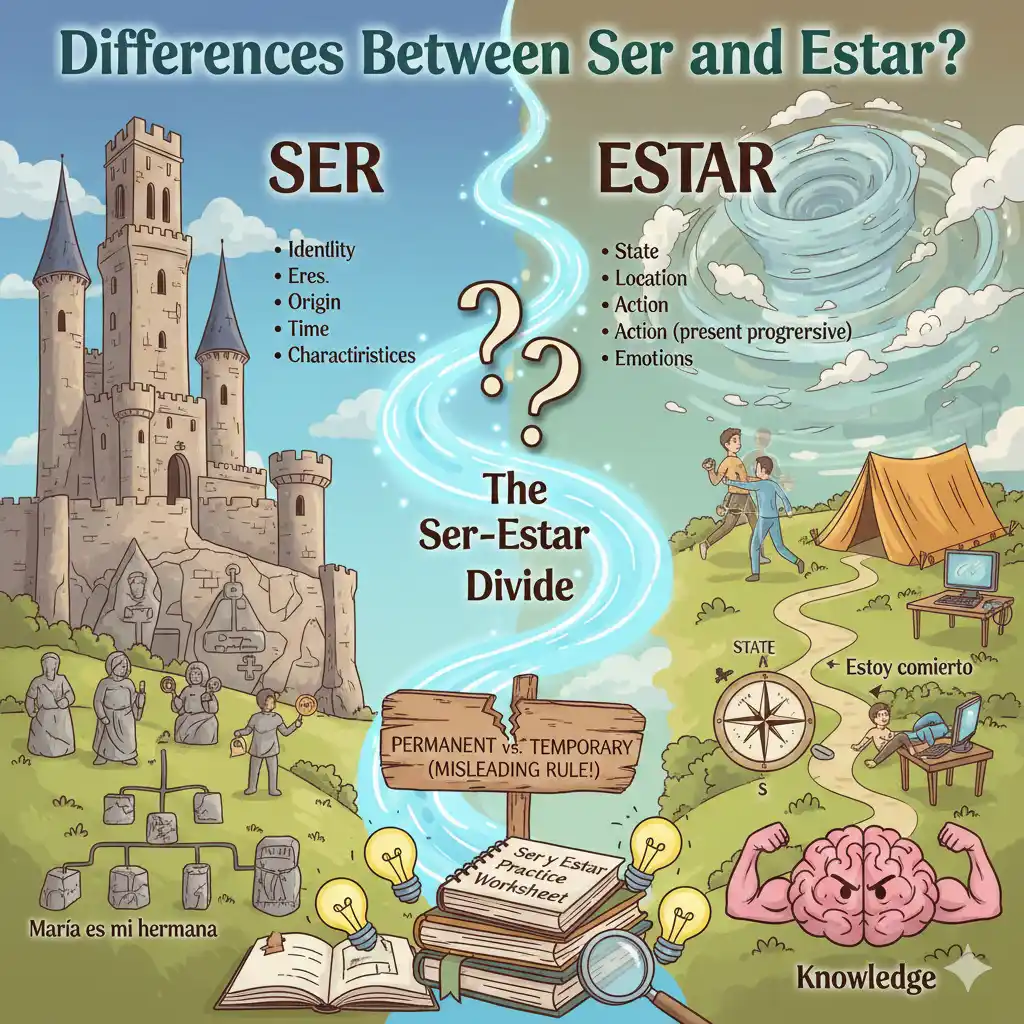
If you think the only difference between ser and estar is that one is used for permanence and the other for temporary things, stick around.
And if what you want is a detailed and well-explained answer, you’re more than welcome to keep reading.
The verbs ser and estar can be a real headache for Spanish learners. Their distinction is almost unique to our language, and if you’ve already tried studying them, you’ve probably heard the classic rule that ser is for permanent things and estar is for temporary ones.
But… while this rule has some truth to it, it’s also quite misleading. In fact, more often than not, instead of helping, it only makes things more confusing.
2. An Example That Breaks the Temporary vs. Permanent Rule
If we strictly follow the logic of permanence and temporariness, we might think that the translation of to be dead is ser muerto, because, well, no one comes back to life. However, in Spanish, we say estar muerto.
Why? Because the real key to distinguishing between ser and estar is not whether something is temporary or permanent, but whether we are talking about a state.
3. How to Conjugate Ser and Estar
Both ser and estar mean to be, but they follow different conjugation patterns and are irregular in several forms. Here’s a quick guide to the most commonly used tenses:
SER
PRESENT TENSE
ESTAR
PRESENT TENSE
SER
FUTURE
ESTAR
FUTURE
SER
PRETERITE
ESTAR
PRETERITE
SER
IMPERFECT
ESTAR
IMPERFECT
4. How to Know When to Use Ser or Estar Properly
A simple trick: if it refers to a state, in 80% of cases, you should use estar.
Let’s look at some examples:
5. How to Use Estar in Spanish — Other Uses of Estar
Besides states, estar is used in other contexts that have nothing to do with whether something is temporary or permanent:
6. Learning the Differences Between Ser and Estar Takes Time
Don’t worry if you don’t master them right away. Learning to use these verbs correctly is not something you achieve in a single day, but with a lot of practice, exercises, and, above all, making mistakes and learning from them.
If you want to go deeper and practice with exercises, I recommend checking out my Ser y estar practice worksheet. It will be very useful, and you’ll always have them at hand whenever you need to review, giving you more confidence when speaking Spanish.